
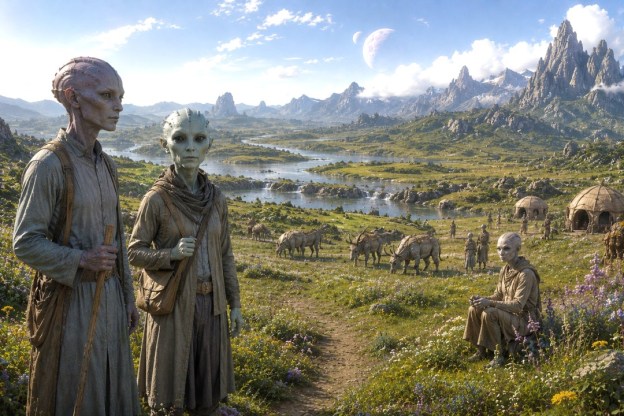
With all the interest in UFOs, UAPs, and reputed alien encounters, this becomes a common question. As Christians, what is our response? Does the Bible allow for the possibility that there are inhabited planets elsewhere in the universe? Well, first of all, let’s clear that there is no absolutely definitive answer. The Bible does not say one way or the other. And Christians disagree about the issue. Let’s examine the matter for ourselves.
YES, THERE IS ALIEN LIFE
First of all, let’s assume that there probably is life on other worlds. Some Christians take this position. One argument for saying yes is the vastness of the universe. Why would God create all those millions and billions of stars, with planets, and not have them populated? It just makes sense that there are populated worlds in this huge universe.
Another argument concerned the idea of God as Creator. Since God is creative, why wouldn’t He continue to create many worlds and many peoples? At the same time, we know that our creative God is also a loving Deity. The Bible says that God is love, and love wants to give. Wouldn’t He want to give more love to more intelligent beings?
We also recognize that this idea is not new. For centuries, some people have believed that other worlds have some form of intelligent life on them. For example, the Medieval theologian Nicholas of Cusa (1401-1464) speculated that there were multitudes of words inhabited by creatures of God’s making. However, he believed that these otherworldly beings are probably of an inferior nature compared with humans. A contemporary of Nicolas was William of Vorilong (1392-1462), a French philosopher and theologian. William thought that there were many inhabited worlds. He also asserted that since they were created separately from Adam, they were not tainted by the effects of sin. Over the centuries, there were some Catholic writers who believed that there was the possibility of life on other worlds. There have also been some Protestants who asserted this idea. For example, Isaac Watts (1674–1748), the famous hymn-writer, said that other planets in our solar system were “fitted for the dwelling of some creatures” as well as planets even further away. Also, Bible scholar and theologian Richard Baxter (1615–1691) wrote that many other planets were populated by God’s creatures. Even today, several Christians have toyed with the idea of life on other worlds, such as C.S. Lewis in his famous Space Trilogy.
NO, THERE IS NO ALIEN LIFE
While some Christians believe that life on other worlds is possible, I do not accept this position. While not being dogmatic, I think that extraterrestrial life is highly unlikely. Indeed, I think that Scripture seems to indicate this. Why?
First of all, the Bible says that the Earth was designed by God to be inhabited (Isaiah 45:18). This is not said of any other world. Notice in this verse that God created the heavens, yet nothing is said of their being inhabited. The Earth is the only world made for inhabitation.
Earth was designed for man’s habitation. That is its purpose. The purpose of the heavens, including stars and planets, is 1) to proclaim the glory of God (Psalm 19:1), and 2) to serve as signs and for seasons (Genesis 1:14). There is no indication that they have any other purpose. As the Psalmist said, the Earth was created for man, and the heavens are for God (Psalm 115:16).
Scripture also indicates that the original mandate for man was to rule over all creation, including other worlds (see Psalm 8:3, 6, and Deuteronomy 4:19). If Adam had not fallen, mankind’s dominion would have extended throughout the universe. The vast universe exists as a vast unrealized potential kingdom for Adam and his offspring.
A further consideration is that all creation was affected by the Fall (Romans 8:20-22). Therefore, all nature is corrupted and needs redemption (Colossians 1:20). That is why the entire cosmos must one day be destroyed and refashioned (2 Peter 3:7, 10, 12). The fate of all stars and worlds is linked to what happens to mankind on this Earth. Why would God need to destroy the entire cosmos if it were not corrupted by sin?
Suppose sentient beings were living on other worlds. We must ask, are they fallen creatures? If so, it would seem that they are unredeemable. Why do I say this? For several reasons: 1) Christ’s blood was able to redeem us because He was of Adam’s blood. They are not descended from Adam. Therefore, there is no provision for their salvation. 2) The Incarnation was a one-time act that is now eternal. Christ will not incarnate again. He has already incarnated once and is now human forever. 3) Christ only offered a sacrifice for sin once (1 Peter 3:18, Hebrews 9:27-28, Hebrews 10:10). There is no other sin offering promised or possible.
But suppose these extraterrestrial creatures are not fallen. Then, this calls into question the justice of God. For it seems unjust that they now suffer the consequences of Adam’s sin in a corrupted, sin-tainted universe. Further, the time will come when their worlds will be destroyed (as noted above) in the final conflagration when God makes all things new (2 Peter 3:7, 12). Is it fair that they suffer for the disobedience of one man on one planet who is not even of the same species or same created order as they are?
I mentioned above that some Christian scholars in the past have speculated that there might be life on other worlds. While this is true, the majority of Christian theologians and scholars have rejected this idea. Thomas Aquinas was adamant that only the earth was made to be inhabited. This was also true of the Protestant Reformers. So, not only the Scriptures, but the consensus of most Christian authorities is that the Earth is the only inhabited world.
MULTITUDES OF WORLDS
Of course, this begs an important question. What do we do with all those millions of planets scattered throughout the universe? I have a few thoughts on this matter.
- God does have a purpose for everything. But He doesn’t have to tell us all his plans (Deuteronomy 20:20). The reason for the existence of multiple worlds may simply be a mystery known only to God.
- They could have angelic purposes. The angels are associated with the stars (Job 38:7, Judges 5:20, cf. Nehemiah 9:6). Perhaps the stars and planets are part of the heavenly operations of God’s kingdom and have nothing to do with humanity.
- They could have been created to be populated by humans sometime in the future. In this regard, I believe God is an optimist. He created the universe as though we would not fall. So He created multiple worlds as potential homes for the seed of Adam’s race. And if Adam had not sinned, perhaps we would be out there right now. But in the current state of affairs, with a fallen human race and a corrupted cosmos, they float lifeless with a lost potential. However, this might change in the coming eternal kingdom of God. We may yet populate these worlds in eternity after God refashions the universe (cf. 2 Peter 3:17).
- They obviously exist to glorify God and teach us about him (Psalm 19:1, Romans 1:20). Maybe their sole purpose is to show us the creativity, infinity, and power of God. No other purpose is necessary. Does not the vastness of the cosmos cause us to marvel afresh at the infinity, power, and majesty of our Creator?
- The universe seems huge to us. So we question why there are such huge spaces and multitudes of worlds. But the entire universe is not huge to God. It is like something he holds in his hand. We are trying to understand the universe from our limited human perspective and natural reason.
- Finally, the vast number of galaxies, galaxy clusters, stars, and planets may all exist solely for God’s own enjoyment. Again, they need no other purpose. They are about Him, not us (see Psalm 8:3-4).
So, what’s the answer? Bottom line: We don’t know for sure. However, the weight of Scripture and Christian theology indicates that it is highly unlikely that God created intelligent physical beings on any other worlds. As far as we know, the only other intelligent beings in the universe are angels, heavenly and fallen. That’s it.

