
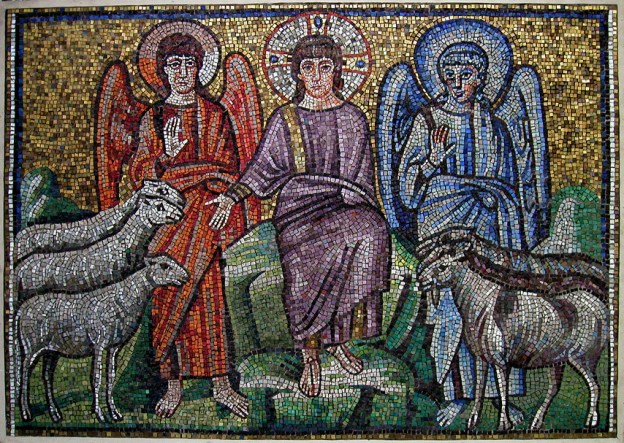
Question: “I have a question, for a lot of religions goats seem to be the main way that they view their gods. Also in Matthew 25:33 it talks about how Jesus will put the sheep on his right and the goats on his left. So my question is, why are goats looked down on and used as demonic symbols. Thank you.” N in Tennessee
My Answer: Good question. A couple of thoughts. In many ancient cultures, the Hebrews among them, goats were a common sacrificial animal, along with sheep. This may probably be simply because goats were so common. Many people raised goats. This is still true today. Indeed, it is believed that goat is the most common meat eaten worldwide. Anyway, goats would have become associated with certain gods through the practice of offering them as a sacrifice.
For early Christians goats became associated with the devil and evil for two reasons.
1) The first is the teaching of Jesus you mentioned. Those who were judged and condemned by Christ were the “goats” on his left hand. Jesus wasn’t probably trying to make goats seem evil. In fact, the Jews would not have considered goats as necessarily evil at all. For example, goats were a legitimate sacrificial animal, and appropriate to sacrificing to the Lord. We usually think of the Passover offering as being a sheep, and it generally was. However, a goat was also acceptable (see Exodus 12:5). Rather, Jesus was stressing the idea of separation of the righteous from the ungodly, just as a farmer would separate flocks of sheep and goats. However, the condemnation of the ungodly on his left caused goats to be associated with evil in the minds of many people. It is also interesting to note that in many cultures the left hand is associated with evil. Indeed, the very word “sinister” comes from the Latin word for “left.”
2) There were some pagan gods that were associated with goats. Prominent among them was Pan, the forest deity that was half man and half goat. Pan was a popular god among the common people. Farmers and rural people frequently identified with this wild deity of the countryside. It should be noted that in the days of the Roman Empire the church grew first and foremost in the cities. The rural people largely remained pagan. Indeed, the word “pagan” originally meant a country dweller. Since the early Christians rightly considered idolatrous gods as demons, Pan and satyrs (goat-men) became associated with false worship and honoring demonic gods. Then gradually the horns and cloven hooves of Pan were transferred to images of the Devil himself. In the Middle Ages Satan was often depicted as being a horned creature. Sometimes he was goat-like in appearance. At other times he appeared more like a wolf, or even some type of fantastic bird-headed beast. Yet the horns and cloven hooves were pretty consistently featured.
In modern times Satanists and devil worshipers have capitalized on this tradition and taken the goat head as a common symbol. Indeed, the most common image used by the Church of Satan is a goat’s head within a pentagram. Historically this is rooted not only in ancient and medieval images of a goat-like Devil, but in the literature of 19th century occult literature. It was asserted the “god of the witches” as the so-called Goat of Mendes. This was a winged and goat-headed hermaphroditic figure with a pentagram on its forehead.
The bottom line should be this: Although as a symbol goats have commonly become associated with the devil in religious and occult symbolism, actually there is nothing inherently evil about these creatures made by God. Indeed, anyone that I know who has ever owned goats loves them. They are said to be gentle, intelligent animals that people enjoy raising.

 TRUTH BUILDERS MINISTRIES