

Question: Someone has asked me about the Enneagram. What can you tell me about this? (T. in Virginia)
Answer: The Enneagram is extremely popular right now. Use of the Enneagram is found in the business world. Psychologists use it in analyzing their patients. New Age cults use it as an instrument for helping people to achieve spiritual enlightenment. Christians are using it as a tool to understand themselves and others, and to guide them in their prayer life. The possible uses of the Enneagram seem endless, according to its advocates.
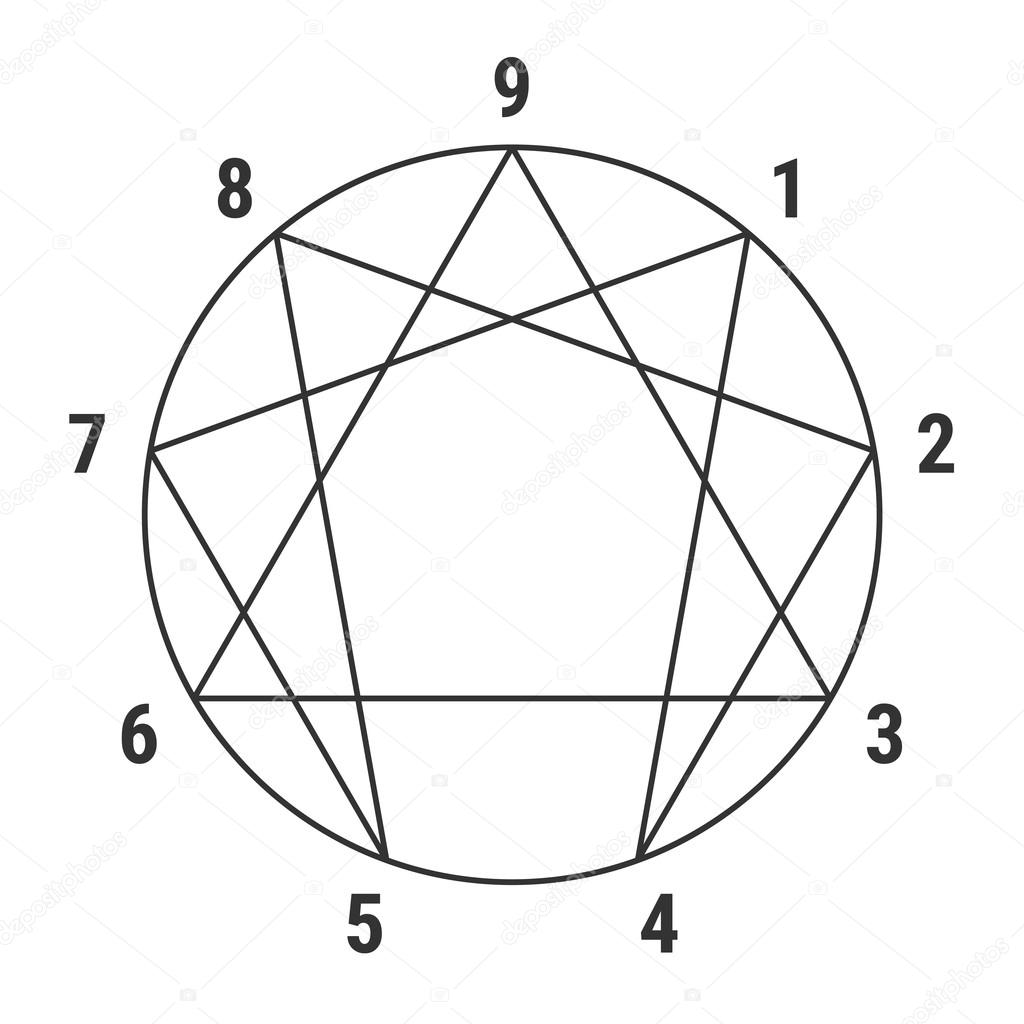
The Diagram
The word Enneagram itself is derived from the Greek words for “nine” and “writing” or “drawing.” So the Enneagram is literally a figure consisting of nine drawn lines. The Enneagram is a complex, intriguing diagram. It consists of a circle with the numbers 1-9 evenly spaced around it. The numbers 3, 6 and 9 are joined by an equilateral triangle. Numbers 1, 4, 2, 8, 5, 7, and then 1 again are connected to form a symmetrical hexagram form.
Personality Types
The Enneagram is used for many different things. And there are various interpretations of its significance. However, the supposed ability to model and define personality types has been the reason for its widespread popularity. The Enneagram illustrates nine different personality types. Although those who use the Enneagram acknowledge the complexity of human nature, they still assert that all human beings can basically be understood through these nine types. (See the diagram below.) Different groups and organizations have their own individual descriptions of the nine types. However, they generally agree in a basic description of each personality type. You may determine your personality type by reading a description of each type, and deciding which one corresponds with your perception of your own personality. There are also diagnostics available from various companies and organizations. These diagnostics each ask a series of questions. Your responses determine your personality type. Once you have discovered your personality, you can then go on to learn about your strengths, weaknesses, problem areas, addiction tendencies, emotional responses, relationship patterns, etc.
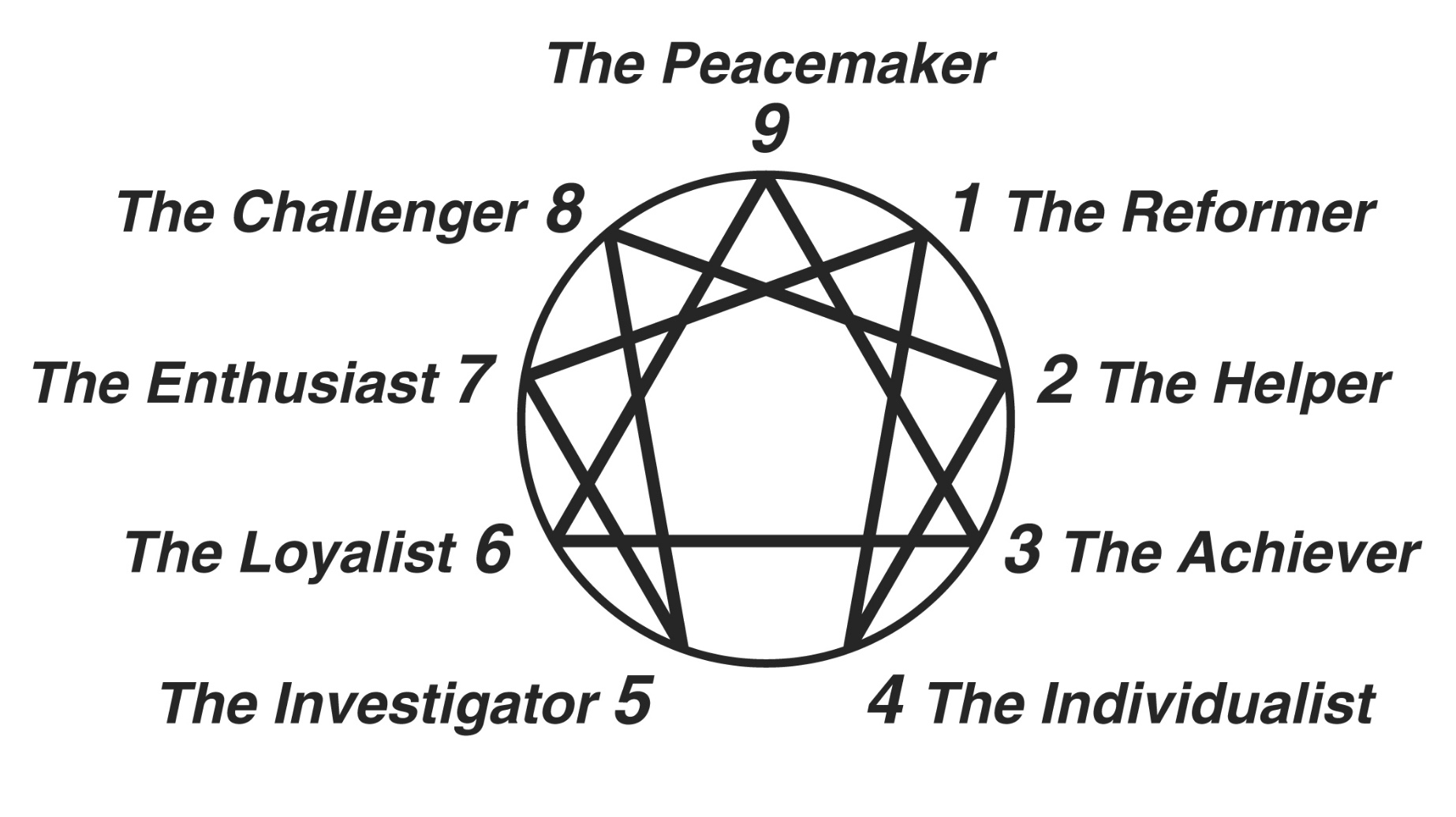
In addition to your primary personality type, you also have one or two wings. What this means is that you show a tendency to demonstrate the characteristics of the types close to you on the Enneagram. For example if you are an eight (Challenger), you may have a wing of either Peacemaker or Enthusiast, or perhaps both. The Enneagram types are also divided into three basic categories—Head, Heart and Gut. Types 5, 6 and 7 are Heart types. They tend to be doers, action oriented. Types 8, 9, and 1 are Gut (or Belly) types. They are oriented to relationships. Types 2, 3 and 4 are Heart types. They tend to be concerned with feelings.
Proponents of the Enneagram claim that it not only defines and provides understanding of personality types, but that it is a great therapeutic tool. It can help people understand their emotional responses to life. It can reveal patterns of behavior. It can explain why people interact as they do. It reveals virtues and vices. It has almost unlimited potential for diagnosing and helping the human condition.
Mythic History
No one is exactly sure who first developed the Enneagram or who used it first. Those who believe in its effectiveness often make claims for its great antiquity. It said that it can be traced to Plato and the neo-Platonists. Pythagoras and his disciples supposedly were familiar with the Enneagram and considered it a sacred diagram. Some claim that the ancient Chaldeans used the Enneagram; some that it can be traced to the Sufis, Islamic mystics. There are those who draw parallels with Jewish mystical system known as the Kabbalah. They believe that the mystical Tree of Life is connected to the Enneagram. There are still others who say that it was used by early Christians, especially the Desert Fathers. They assert that the Seven Deadly Sins were originally derived from nine vices defined by the Enneagram.
However, the first use of the Enneagram that can actually be documented is in writings about the 20th century occultist Georges I. Gurdjieff.
Gurdjieff
Gurdjieff was born in Armenia of Armenian and Greek descent. He traveled many places throughout the world seeking spiritual truth. In this spiritual journey he became acquainted with many religions, occult practices and mystical systems. He became a follower of Sufism, a mystical school of Islam. His unique teachings on human nature and self-realization were a combination of mystical Christianity, Buddhism, Sufism and the occult. Gurdjieff used the Enneagram, and considered it a powerful instrument for spiritual enlightenment. He believed that the Enneagram represented the entire cosmos.
The first actual publication of the Enneagram was in the writings of P.D. Ouspensky, a disciple of Gurdjieff. He states that Gurdjieff revealed the Enneagram to his followers in 1916. According to Ouspensky, Gurdjieff believed this was an ancient, mystical image that he was releasing for the first time. It supposedly explained much spiritual truth, including the real meaning behind the Philosophers Stone. For Gurdjieff, it was a moving, active, powerful mystical reality that only the initiated could understand.
Arica
The next appearance of the Enneagram is in the teachings of a Bolivian-born New Age mystic named Óscar Ichazo. In Gurdjieff’s use of the Enneagram there was no mention of personality types. Ichazo is the one who developed and promoted this idea.
Ichazo was the founder and leader of a New Age cult called Arica, named after a city in Chile where Ichazo lived and taught his philosophy. As is common with most New Age groups, Arica is a syncretistic mixture of many influences—in this case, Sufism, Eastern religion, the occult and the teachings of Gurdjieff. Ichazo also encouraged the use of psychedelic drugs to help achieve enlightenment and spiritual visions.
His use of the Enneagram is part of a larger system called Protoanalysis ®. The purpose of Arica is to help mankind achieve spiritual enlightenment and recognize our latent divinity. Although Ichazo was apparently influenced by Gurdjieff, he later denied any connection. He claimed that the Enneagram (which he called an Enneagon) was revealed to him by an angelic being while he was in a mescaline-induced trance. The name of this spirit being is variously given as Metraton or the “Green Qutub.” It should be noted that Metraton (also Metratron) was an archangel in the occult systems of the Kabbalah and Gnosticism.
Coming to America
One of the Ichazo’s disciples was a Chilean psychiatrist named Claudio Naranjo. Naranjo came to the U.S. and in the 1970’s began to train students in the use of the Enneagram. This was mainly in Roman Catholic communities, especially those with a contemplative or mystical tendency. Among those who taught the effectiveness of the Enneagram were a Franciscan friar Richard Rohr, a Benedictine nun named Suzanne Zuercher, and a former Jesuit named Don Riso. In 1997 Riso helped to found the Enneagram Institute, an organization which has done much to popularize and spread the use of the Enneagram.
Since then the Enneagram has become so widespread among Catholics that it has attracted the attention of the Catholic hierarchy. In 2000 the United States Conference of Catholic Bishops Committee on Doctrine issued a statement expressing concern about the Enneagram. This statement summed up its position with these words: “In conclusion, those who are looking for an aid for personal and psychological development should be aware that enneagram teaching lacks a scientific foundation for its assertion and that the enneagram is of questionable value as a scientific tool for the understanding of human psychology. Moreover, Christians who are looking for an aid for spiritual growth should be aware that the enneagram has its origins in a non-Christian worldview and remains connected to a complex of philosophical and religious ideas that do not accord with Christian belief.”
In recent years the Enneagram has become very popular among evangelical Christians. It is generally viewed as simply another personality test, comparable to Myers-Briggs or any of the popular Christian diagnostic tools. It is enough of a fad that you can hear Christians claiming, “I am a 3,” in much the same way as people used to say, “I am a Pisces.”
Spiritual Significance
The Enneagram has become popular simply as a diagnostic tool for understanding personality types. However, for many people it is so much more. Some New Age groups see it as an aid for spiritual enlightenment, much like using a mandala, or engaging in meditation. There are some who see it as a divinatory tool, using it to practice a form of numerology. There are some who advocate its use as an instrument of divine truth. They believe that God has revealed esoteric knowledge through the Enneagram.
Even among some Christians there is an assertion of the spiritual value of the Enneagram. Some proponents believe that each number is a pathway to the divine, and encountering God. Some use the idea of the personality types to develop specific methods of prayer and seeking God. One evangelical writer, Christopher Heuertz, has written a book entitled The Sacred Enneagram: Finding Your Unique Path to God. Heuertz believes that the Enneagram can help us discover our “true selves” and find our personal path to knowing God. (It should be mentioned that Heuertz is a student of Richard Rohr, mentioned above as a Catholic teacher of the Enneagram.)
Potential Problems
Should Christians use the Enneagram? This is a legitimate question. However, there is not necessarily a black and white answer. Most Christians will probably use the Enneagram as a diagnostic tool for understanding personality types. For them, it is probably harmless. Yet, this does not mean that using is not without problems. Let’s briefly consider a few.
- Is It Valid?
Use of the Enneagram has no solid foundation whatsoever. None. There are no studies that it works. None. There is no scientific data to substantiate its effectiveness. The determination of your personality number is basically arbitrary and subjective. There is no objective reason why there should be nine personality types, nor for these particular nine. For this reason, even if a person were to consider the Enneagram harmless, the question should be asked, “Is it useful? Does it work?” There is no reason to believe that it does. People who swear by it, do so because they think it works. But there is no objective evidence to support this.
- A Bad Excuse
As can happen with any diagnostic tool for determining personality, gifting, or skill set, defining yourself as an Enneagram personality number can become a good excuse for bad behavior. Among some Christians being a 3 means that you don’t have to do certain things. Or they claim, that’s “not how 4’s act, so don’t expect it of me.” This tendency has become so common that Christian comedian John Crist has made a Facebook video poking fun at Christians who use the Enneagram to excuse their bad attitudes and actions. Our standard of behavior must be rooted in the commands and expectations of the Scriptures, not our Enneagram number.
- A Poisonous Root
Whether you ever pursue use of the Enneagram as a spiritual instrument or not, you still cannot escape the history of its origins. The Enneagram is rooted in occultic and cultic belief systems. It is founded on a completely non-Christian, indeed anti-Christian worldview. The fact that the concept of the nine personality types was revealed by a demonic spirit to a New Age mystic in a drug-induced trance should not be dismissed lightly. At the very least, an attitude of caution should be evident in using the Enneagram.
 TRUTH BUILDERS MINISTRIES