
“Small minds are concerned with the extraordinary, great minds with the ordinary.”
~ Blaise Pascal
One of the foibles of human nature (and tragedies of life) is how we can get used to almost anything. Even the sacred. Consider the Passover celebration. This ceremonial meal celebrates one of the most extraordinary events in the history of not only Israel, but the world—the Exodus of Israel from Egypt. By command of God, the Children of Israel observed the Passover each spring—the roasted lamb, the unleavened bread, the bitter herbs. Year after year, the same ritual, the same four questions, the same menu. All of it so familiar.
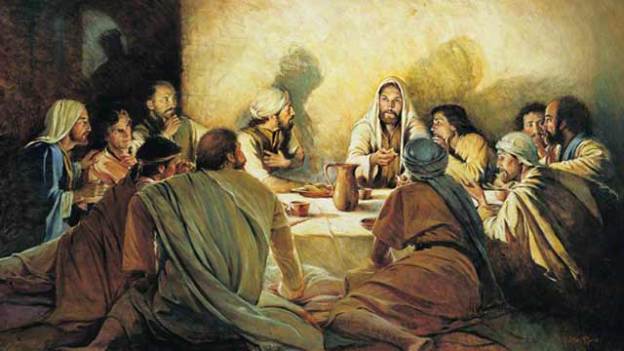
I daresay for some of the disciples what we call “the Last Supper” seemed no different. They had been with Jesus for three years now. They had often eaten with Him. They had even celebrated the Seder with Him at two different Pascal celebrations. So they knew what to expect. Yes, this was a sacred event, recalling the Lord’s deliverance of their forefathers. And I am sure there was some excitement, anticipating the joy of the night, the thrill of the season. But they knew what to expect. They had done it all before. But then, well, the Master surprised them. Let’s enter into the scene as recounted in Matthew 26:26-29.
They have enjoyed the rituals of remembrance that a seder employs. They have eaten the matzoh, partaken of salt water and a green vegetable, probably choked and coughed on the bitter herbs. They had already drunk two cups of wine. Now it is time for the third when Jesus suddenly interrupts the ritual. He reaches over and picks up a piece of unleavened bread. He blesses it and breaks it, and says incredible words: “Take this. Eat it. This is My body.” As the bread is being distributed around the table, the disciples ponder what these strange words could mean. His body? How can that be?
Then the Master picks up the cup, the third cup of the Passover seder (the Cup of Redemption, by the way), and He declares, “All of you, drink of this. This is My blood of the covenant, which is poured out for the forgiveness of sins.” Again, strange words—strange indeed! What is the Master saying? What can He mean by this?
What does this all mean? Of course, that is a matter that has been discussed and debated by the church through the centuries. And although we may not know, perhaps cannot know, all that Jesus meant by these words, still there is something we can know. Jesus was instituting a memorial Supper that would forever remind His followers of His great sacrifice for them, of His great love for them. Yet He was not only commanding them to observe this Supper, He was inviting them to join in an amazingly intimate relationship with Him, made possible through His broken body and shed blood. He was opening the way for His very life to enter into their very hearts and souls. He was proclaiming salvation and redemption for them, and for all humankind.
And He did this at a meal, with ordinary bread, with ordinary juice from a grapevine. If we could see through the eyes of those disciples we would not see anything extraordinary in this scene. We would only see lamplight, a table spread with plain food, and a gathering of simple, rough men of the earth. We would not see any halos, or glowing chalices, or supernaturally glimmering dinnerware. None of that. Just dull, commonplace bread; tasty but basic wine; and a rather normal looking rabbi who happened to be saying the most extraordinary things. We would see an ordinary, yet wonderful, meal that foreshadowed the Lord’s Passion and Death—and would forever point His followers back to the awful, yet wonderful, events of that ancient Good Friday.
Perhaps this idea of the common masking the remarkable can inform all of us of the true meaning of the Lord’s Supper. Communion will always be a mystery, I think. Yet, I know that in the bread and the cup I remember the Lord’s death. And I also know that something more than just remembrance happens. I encounter Him. I meet with my Savior. I enjoy not only the Communion observance, but I experience true communion with my Lord. What is truly ordinary is at the same time something astonishingly supernatural and extraordinary.
Perhaps this idea also can inform each of us of a better way to live our lives. We would do well to consider the importance of the ordinary, the common—and understand these are the very things that God uses most often. This is especially needed in our modern society. We are often addicted to glitz and glamor, celebrity and sophistication. Sad to say, we think we are so smart and so “cool,” but the truth is we live in an inside-out, backwards world—so different from the world of God’s reality. His is a world where the common and ordinary is His favored medium of operation.
Consider how often in the history of God’s people it has been the ordinary that God uses. One of my favorite examples is the story of Corrie ten Boom. If you have not read The Hiding Place, or any of Corrie’s other books, you really must read them. Here is the story of a rather plain Dutch family, yes, but a family wholly committed to God. The ten Booms also had a love for the Jews, the Lord’s Chosen Race. During the Second World War they hid Jewish refugees in their home, and helped to smuggle them out of Europe. But their work was eventually exposed. Members of the family were imprisoned and then sent to a concentration camp. There Corrie ten Boom, and her sister Betsie suffered greatly under unbelievably harsh conditions. Betsie would die in Ravensbruck Camp. Yet, through a miracle of God, Corrie was released. After the war was over God called Corrie into ministry—first in Holland, then Germany, then around the world. For decades Corrie traveled telling about her experiences, and how God is greater than any hardship we face in life. God used this rather dowdy, middle-aged spinster to proclaim the message of God’s love and forgiveness around the globe. How many thousands, if not millions of people, have been impacted by this common, ordinary woman?
Another moving story of God using the ordinary is the story of Edward Kimball. In the mid-1800’s Kimball taught a Sunday School class for young men at Mount Vernon Church in Boston. Kimball had a deep passion for the souls of his class. He made it a habit to visit his boys during the week, to share his faith and see about their spiritual condition. One young man who began attending his class especially grabbed Kimball’s heart. Even though he did not know the young man, Kimball decided to visit him. He went to the shoe store where the boy worked and shared his faith with this youth, which resulted in him accepting Christ. That young man was Dwight L. Moody. Years later, Moody would remember this time: “I used to attend a Sunday school class, and one day I recollect my teacher came around behind the counter of the shop I was at work in, and put his hand upon my shoulder, and talked to me about Christ and my soul. I had not felt that I had a soul till then. I said to myself, ‘This is a very strange thing. Here is a man who never saw me till lately, and he is weeping over my sins, and I never shed a tear about them.’ But I understand it now, and know what it is to have a passion for men’s souls and weep over their sins. I don’t remember what he said, but I can feel the power of that man’s hand on my shoulder tonight.” Think of that, an ordinary Sunday School teacher was used of God to bring into the Kingdom one of the most effective preachers the church has ever seen.
These are only two examples among thousands that could be cited. For this is how God works: the ordinary, the plain, the simple are God’s vehicles for the marvelous and the miraculous. Here then is our challenge—to not miss what God is doing all around us, and what He wants to do through us. It might be your simple words of faith that bring another Billy Graham to Christ. It might your everyday prayers that spark a revival that changes the world. It might your widow’s mite offering that makes the difference in reaching a nation with the Gospel. It might be a plain, ordinary supper where you encounter the very Presence of the Lord Jesus Christ Himself.
 TRUTH BUILDERS MINISTRIES