
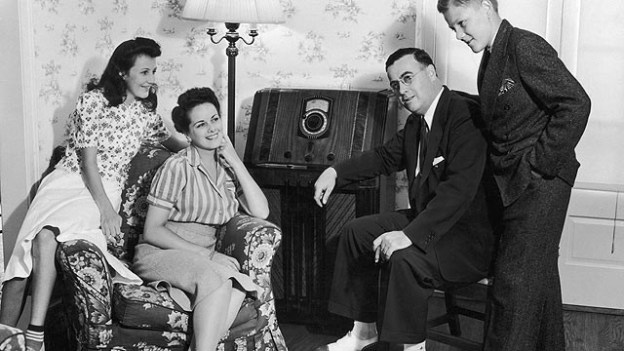
In the 1920’s and 30’s the cutting edge of technology was wireless telegraphy, better known today as radio. Herbert W. Armstrong, an Adventist evangelist, saw the potential of this medium and used it to his advantage. He began broadcasting his unique views of the Bible in 1933. His abilities as a speaker won the minds and hearts of thousands of listeners. Thus was born the Radio Church of God, a religious organization that initially consisted almost completely of a radio audience. Eventually Armstrong’s following grew to become the Worldwide Church of God.[i]
The progression from a small radio broadcast to an on-air “church” to an organized religious body demonstrates the power of electronic media to effectively propagate a message and develop a committed group of adherents. Thus, Armstrongism serves as a prime example of how cults can, and often do, effectively use technology and media to spread their own versions of the gospel.
Another group that effectively made early use of radio was the Watchtower Bible and Tract Society. In 1923 the Watchtower Society (more popularly known as Jehovah’s Witnesses or JW’s) bought the equipment of a closed radio station. They established their own radio outlet, WBBR, in February 1924, becoming one of the first religious organizations to enter the world of broadcasting. By 1928 the Witnesses were broadcasting on 96 stations, having created the largest radio network of that day. For the time, they were at the forefront of contemporary media usage.
However, they did not stay on the cutting edge. Decades later, when the Internet came on the scene, they were slow to take advantage of this new technology. But others were not so hesitant. A number of cult watchdog groups, as well as Christian ministries operated by ex-JW’s, saw the benefits of using the Internet. Many of the Scriptural errors, doctrinal contradictions, and even false prophecies of the Watchtower Society were exposed through various websites. The leaders of the Watchtower responded with their usual tactic in such cases: Fear and intimidation of its members. They warned that connecting to the Internet “can open the way to serious spiritual dangers” and that Witnesses could be exposed to “poisonous elements” on such sites. The directive was straightforward: “Christians [i.e., Jehovah’s Witnesses] look to ‘the faithful and discreet slave’ for timely spiritual food and for clarifications.”[ii] In other words, the Society was forbidding Jehovah’s Witnesses from surfing the Internet or looking at any website unless their leaders specifically approved it.
It should be noted though that since then the Watchtower Society has launched its own attractive, interactive website. The Society has learned a lesson from their detractors and now uses the Internet to effectively promote its false gospel. On the official JW website you can read articles on hundreds of topics, dealing with everything from theology and sexual mores to prophecy and marital advice. The New World Translation, the Watchtower’s own distinctive version of the Bible, is available to read online. You can order printed publications (still the backbone of the Society’s media outreach). Or you can schedule an appointment for a Witness to come to your house and conduct a “Bible study” (or more accurately a book study promoting their doctrinal views).
When we examine how cults use technology with great effect perhaps no group stands out more prominently than the Mormons. We are all familiar with the positive, pro-family TV messages brought to us by the Church of Jesus Christ of Latter-day Saints (or LDS). (“Positive” messages which belie the heretical and even demonic elements of the LDS Church.) Through the use of television commercials, videos, the Internet, and other contemporary media the Mormons have effectively promulgated their gospel in the mass market. Indeed, they seem ubiquitous in this regard. They have their own radio channel streaming LDS programs 24 hours a day, cable television channels, a strong social media presence, “Mormon Messages” on YouTube, and several sophisticated websites.
The Latter-day Saint Church has released its own LDS iPhone application. In addition, you can access downloadable local church information (ward and stake directories) for your Blackberry. If that were not enough, now you can research Mormon Scriptures and doctrinal manuals on PDA’s for Palm and Pocket PC readers, or you can read the LDS gospel library using an iPad app. Would you like an email subscription of Mormon news, or RSS feeds, or have text messages sent directly to your cell phone with the latest LDS current events? It’s all available. Indeed, it seems that if you are wired in any way, then Joseph Smith and Moroni are ready and available to connect with you, no matter where you are!
The efficiency with which the Mormons use these various electronic media is truly astounding. For example, one Mormon blogger shared how he engaged in an online chat with a curious non-Mormon woman.[iii] She requested a copy of the Book of Mormon. After the online chat session was over, the blogger sent a text message to the appropriate local missionaries with the woman’s contact information. Within 15 minutes of the woman’s request, two Mormon missionaries were on her doorstep, Book of Mormon in hand and ready to present the “restored gospel” as found in Latter-day Saint theology.
It should be noted that such proselytizing efforts are strongly encouraged by the Mormon Church leadership. They are determined and they are purposeful in their efforts to use modern technology to advance their “gospel.” Consider the following exhortation from Elder M. Russell Ballard, an Apostle of the LDS Church, given in a commencement speech at Brigham Young University—Idaho in 2008:
“In 1996 President Gordon B. Hinckley said, ‘I constantly ask myself, “What can I do to help 50,000 [LDS] missionaries who are laboring so diligently in the mission field?” If we could find a way for people to constantly bump into the gospel in the normal course of their lives, rather than waiting for missionaries to knock on their doors, it would be one of the greatest things we could do.’ My brothers and sisters, is there any easier way for people to ‘bump into the gospel’ than on the Internet. Remember, every month there are 60 billion Internet searches!”[iv] It is worth noting that if you Google “missionary” then LDS missionary is conspicuous on the first page, and Google images for “missionary” is predominately Mormon. They have learned to optimize well to have such a prominent face on Google.
The Internet is an especially effective tool for cult evangelism and indoctrination. Probably one of the reasons for this is the aura of authority that is given to online data. For many people, if it is found on the Internet then it must be true. (Have you ever heard someone say, “But I read it on the Internet”?) Cult leaders take great advantage of this perception and use it to further their agenda. Often with disastrous results.
Remember the Heaven’s Gate cult? This admittedly wacky UFO cult never attracted great masses of people. But they did attract a fanatically loyal small following. Initially this occurred through gatherings of UFO groups. But then the cult leader, Marshall Applewhite, discovered the power of an online presence. Applewhite not only sought converts via the Internet but he used the cult’s website as the primary means of communicating with his followers. In addition, the cult also recruited computer-savvy followers, who were then employed as Web designers for the business community. The end result was not only an increase in discipleship, but committed workers who generated income for the cult.
Eventually Applewhite’s cyber messages were controlling the lives of the cult’s devotees to the point that when he announced in 1997 that the comet Hale-Bopp was actually a disguised space ship that was coming to take all true believers to their celestial home, dozens of Heaven’s Gate disciples voluntarily committed suicide so that they could spiritually rise to join their alien brethren.
Considering the above facts and accounts, how may the church respond appropriately? First, let us be aware of what is going on. The potential of modern technology is amazing. Unfortunately, heretical cults are ably using this potential to their benefit. We cannot be caught spiritually napping while this occurs. In addition, we must be proactive in our own use of this potential. We have the truth; and we must use every available means to declare the truth. The challenge for the church is that she will through contemporary media and technology raise her voice and in strident tones once again proclaim the truth of God to a lost and blinded world. This is the only antidote to the false gospel being offered by the cults.
Notes:
[i] It should be noted that after the death of Herbert W. Armstrong that the Worldwide Church of God changed its doctrinal position on a number of key issues, bringing it more into line with a biblical, evangelical understanding of Christianity. The Worldwide Church of God is generally no longer considered a cult. However, there are dozens of splinter groups that still adhere to Armstrong’s original teachings. Many of these are very effective in the use of various media, especially television.
[ii] Watchtower, August 1, 1993, p. 17. Quoted: www.ecclesia.org/truth/jw-2.html . It should be noted that in Watchtower parlance the “faithful and discreet slave” is the Watchtower Society and its leadership.
[iii] Account from Greg West as found on www.examiner.com/lds-church-in-national/using-technology-to-bless-lives?render=…
[iv] Transcript of speech found at www.byui.edu/Presentations/Transcripts/Graduation/2008_04_11_Ballard.htm
 TRUTH BUILDERS MINISTRIES