
There are some who attack Christianity as being a “white man’s religion” and they say that the Bible is a “white, European, racist book.” Such assertions are not only false, they are ridiculous to the point of being absurd. Those who make such assertions apparently have no true acquaintance with the Scriptures and it’s content. The Bible is at its core a Hebrew book written from the perspective of Middle Eastern Jews. Indeed, every book of the Bible was written by a Jew, except for the New Testament books of Luke and Acts. How can a book that is Jewish and Middle Eastern be considered a European, Anglo or white man’s book?
However, even though the Bible is largely Hebrew in perspective, it is also a multi-cultural book. It reflects the influence of other cultures—e.g., Egyptian, Mesopotamian, and Hellenistic—on the people of Israel. It also records encounters with individuals and people from a variety of ethnic and cultural backgrounds. And this includes individuals and groups from the continent of Africa. In this writing we will examine some of what the Bible says about Africa and Africans. But first, let us examine the origin of the people groups of Africa as recorded in the Scriptures.
In Genesis 10 we have a remarkable ancient document. This “Table of Nations” lists the descendants of Noah and his three sons. According to this document, and both Jewish and Christian teaching, the origins of the peoples of the earth can be traced to these genealogical roots. Genesis 10:6-20 lists the lineage of Noah’s son Ham. From Ham came a diversity of ancient peoples: Canaanites, Philistines, Egyptians, Assyrians, Babylonians, Akkadians. In addition, the peoples of sub-Saharan Africa are descended from Ham’s son, Cush. For this reason, in the Bible the African nations are generically designated as “Cush.”
The Hebrew terms “Cush” or “Cushite” is used 57 times in the Bible. Often this is translated as “Ethiopia.” (Note that in ancient Egyptian documents what we now call Ethiopia was referred to as Kesh. Kesh was considered the southern boundary of Egypt.) However, this does not necessarily always refer to the modern country of Ethiopia. At times the designation Cush seems to refer the region that now comprises the country of Sudan (ancient Nubia). Some suggest that Cush may generally refer to Africa as a whole. Thus, when the Bible makes statements about Cush, it could be referring to what is now the modern Sudan, to modern Ethiopia, or to the entire sub-Saharan African continent.
It should be noted that there another region associated with the name Cush. This Cush is found in Asia, in Mesopotamia. It may be that Cushites migrated here very early, or that this is simply another branch of the Hamitic lineage. (See Genesis 2:3, 10:8-12) Nevertheless, the majority of references to Cush in the Bible are clearly speaking of African peoples.
It is interesting that the word “cush” itself apparently means “black.” The skin color of the people of Cush was proverbial in ancient Israel (see Jeremiah 13:23).
There are numerous references in the Bible to the children of Ham, the Hamitic peoples. Below is a partial list of some of the significant passages. This is by no means exhaustive.
Old Testament
- Moses had a wife from Cush (Numbers 12:1ff). It is unclear whether this was Zipporah, or a second wife.
- The Psalmist speaks of the people of Cush coming to worship God: “Princes shall come out of Egypt; Ethiopia shall soon stretch out her hands unto God.” – Psalm 68:31. The ancient church fathers loved this passage, which they saw as an image of the Gentile bride of Christ.
- Psalm 87:3 prophesies that the children of Ethiopia will one day be enrolled among the redeemed citizens of Zion.
- Apparently a group of Cushites established a colony in southern Palestine. This may have been early in Israel’s history. The possession of the inheritance of the tribe of Simeon included land previously inhabited by Hamites (1 Chronicles 4:39-40). There was a Cushite who served as a messenger for David’s army (2 Samuel 18:19ff). During the Judean monarchy there was a group of Cushites to the south, but whether these are the same as those mentioned above or another group is unknown (see 2 Chronicles 21:16). These may have come as soldiers who were part of several invading armies. This may have been during the reign of Rehoboam (2 Chronicles 12:1-4), or during the reign of Asa (2 Chronicles 14:9-15).
- It is interesting that the prophet Zephaniah is the son of Cushi (Zephaniah 1:1). This may simply have been his father’s name; cf. there was a Benjaminite named Cush (title of Psalm 7). Or perhaps Zephaniah’s mother married one of the Cushite people living on the borders of southern Israel.
- One of the most famous incidents in the reign of Solomon was the visit of the Queen of Sheba (1 Kings 10:1-13, 2 Chronicles 9:1-12). The exact location of Sheba has long been debated. Many scholars feel that it was in southern Arabia, the location of modern Yemen. Others assert that Sheba was on the other side of the Red Sea, in what is now Ethiopia. Some speculate that the kingdom of Sheba may have occupied both sides of the Red Sea, thus accounting the legends associating Sheba with Africa.
- Isaiah prophesied that the Lord would call His people to come from Ethiopia (Isaiah 11:11).
- Isaiah 18 is a prophecy against the people of Ethiopia. But then in verse 7 we see the situation turned around, as the people of Ethiopia are viewed as a present offered to the Lord himself in Mount Zion.
- For a time the Cushite people ruled on the throne of Egypt. This was the 25th or Cushite dynasty. During this period, several Cushite pharaohs made alliances with the kings of Israel (Hoshea in 2 Kings 17:4) and Judah (Hezekiah in 2 Kings 19:9 and Isaiah 37:9).
- Jeremiah was helped by an Ethiopian man named Ebed-melech (Jeremiah 38:7-13). Ebed-melech was a eunuch, and apparently an advisor to the king. Since Ebed-melech was faithful to God, and kind to Jeremiah, the Lord promised blessings on him, even as judgement was coming on Jerusalem (39:15-18).
- Zephaniah 3:10 prophesies that Africans from “beyond Ethiopia” will come to bring an offering to the Lord.
New Testament
- The northern African city of Cyrene is mentioned several times in the New Testament. This was a city established by the Greeks. It was a very cosmopolitan city. So when someone is said to have been from Cyrene, their ethnicity is uncertain. They may have been Greek or Roman colonists. As there was a large Jewish population in Cyrene, they could have been Jews. Or they may have been indigenous black Africans. Here are some of the references:
1) Simon of Cyrene was forced to carry the cross-beam of Jesus to Calvary (Mark 15:21).
2) Simon was the father of two well-known believers, Alexander and Rufus (Mark 15:21, Romans 16:13).
3) Acts 11:20-21 mentions believers from Cyrene who were active in sharing their faith.
4) Lucius of Cyrene is mentioned among the prophets and teachers of the early church in Antioch (Acts 13:1).
- Another believer mentioned in Acts 13: 1 is a disciple named Simeon, who was also called Niger. Niger is Latin for “black.” It is uncertain, but he may have been an African black man, living in Antioch.
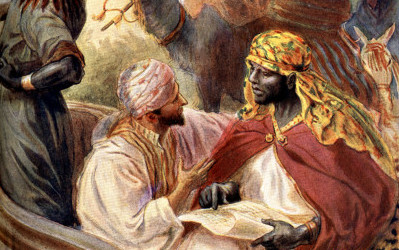
- In Acts 8 we read of the encounter of Philip with the Ethiopian Eunuch. It is said that he was the servant of Queen Candace. Candace was the royal title of the Queen Mother of Nubia, in the land we now call Sudan. The Nubians had established a very cultured society, in which Greek was commonly spoken at court. Therefore, it would not have been unusual for this convert to Judaism to be reading the Septuagint. Philip, likely a Greek-speaking Jew, could have easily conversed with the Eunuch, and explained the Gospel to him. Thus, one of early converts to the faith was a black man from Africa!
In the post-biblical period we continue to see the influence of Africans in the early church. Many of the church fathers were from Africa. This includes Clement of Alexandria, Tertullian, Athanasius, Cyril, Cyprian, Lactantius, and Augustine among others. Many of these are among the greatest theologians, philosophers, Bible scholars and preachers that the church has produced in its history. The ethnicity of many of these men is unknown. However, it is likely that some may have been Cushite in origin. For example, it is known that Athanasius, that great defender of the doctrines of the Trinity and the deity of Christ, was derisively called the “black dwarf.” These men illustrate the fact that Africans historically have made great contributions to our faith.
The purpose of this article is two-fold. First, we want to point out a neglected and forgotten fact of biblical and church history—the presence and contribution of the African people to our faith. Second, we want this review of Africa in the Bible to serve as a reminder that the Christian faith and the Scriptures are inclusive of all “races,” ethnicities, and nations. The topic of Africa in the Bible is meant to serve as an illustration of this. All peoples of the earth are loved by God, atoned for by Christ, and included in the Lord’s great master plan of salvation (cf. Revelation 7:9). Christianity is not a white man’s religion, a Jewish religion, an African religion—rather it is a faith for all tribes, tongues, peoples and nations.
Truth Builders is a ministry initiative of Advancing Native Missions. However, the content of this site is the personal opinion of Victor Morris, and does not necessarily reflect the opinions, views or conclusions of Advancing Native Missions, its leaders or staff
 TRUTH BUILDERS MINISTRIES